01 / Short answer
COB is primarily an optical and mechanical choice: it can reduce visible hotspots, but density, phosphor quality, profile depth, voltage, cut marks and heat still decide the result.
Designers and builders who need a smooth visible line from a strip, with or without a diffuser
CHECKPOINT / 01
What COB changes in the visible source
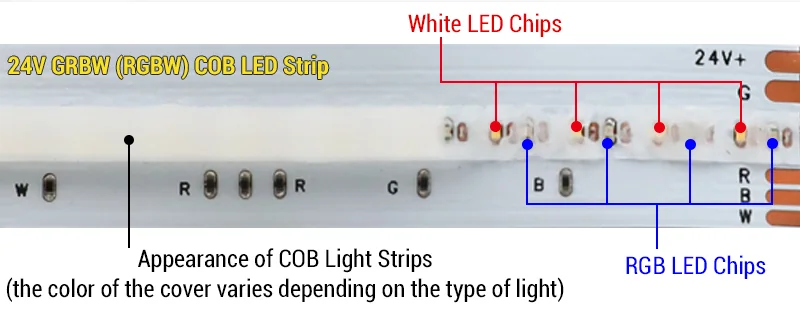
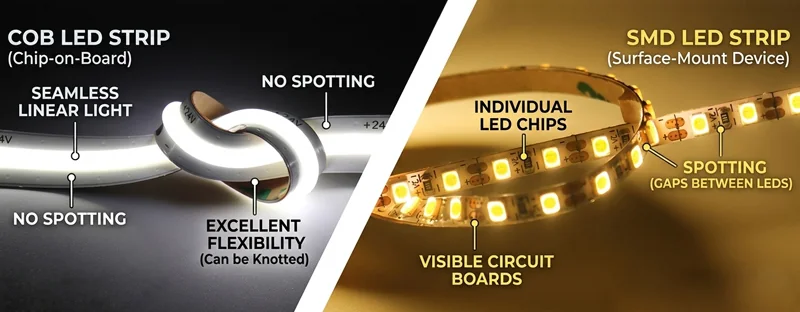
Chip-on-board construction places many small LED chips close together under a continuous phosphor layer. From the viewing side it reads more like a continuous line than a row of individual packages. That is useful in shallow profiles, furniture details and visible linear fixtures, but dotless is not a universal guarantee. A low-density or poorly matched COB strip can still show scalloping, and a diffuser can change both uniformity and output.
- Judge uniformity from the intended viewing distance, not only from a close-up photo.
- Ask for density, watts per metre, color quality and cut interval for the exact variant.
- Do not treat a seamless appearance as proof of high CRI, high efficiency or low temperature.
CURRENT PRODUCT RECORDS
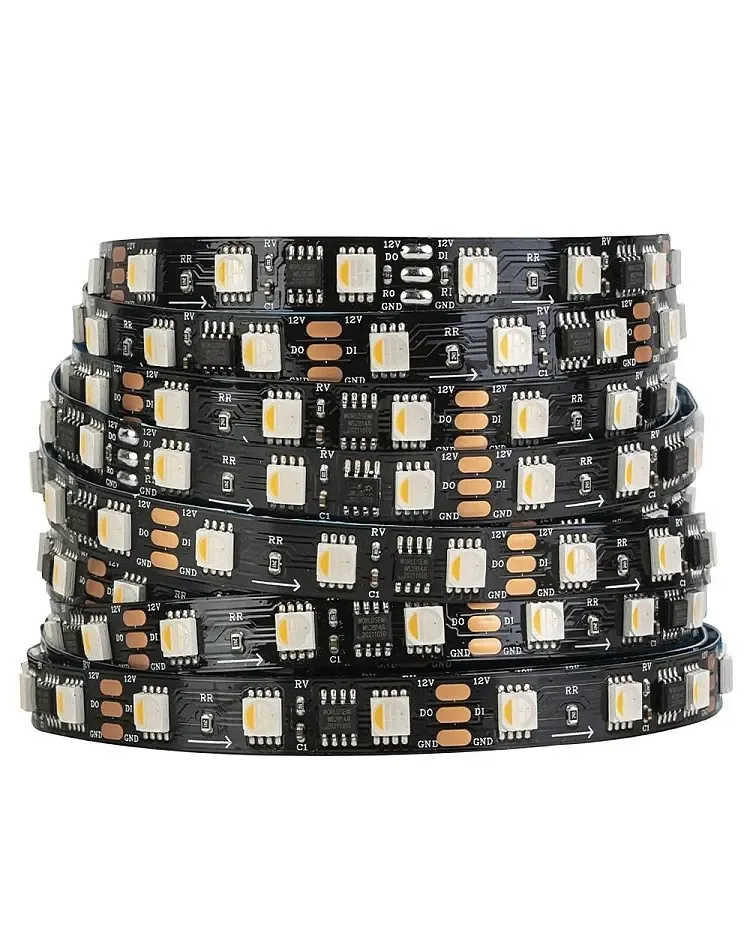
24 V WS2814 RGBW addressable LED strip View productCHECKPOINT / 02
Choose COB or SMD from the job
COB is a strong candidate when the light source will be visible, the profile is shallow or a continuous line is the priority. Conventional SMD remains useful when a particular package, channel output, connector system or replacement strategy matters. Compare the complete assembly at the target brightness: strip, profile, diffuser, surface finish and viewing angle. The best choice is the one that meets the visual requirement without hiding a thermal or service problem.
- Visible line or shallow profile: start with a high-density COB sample.
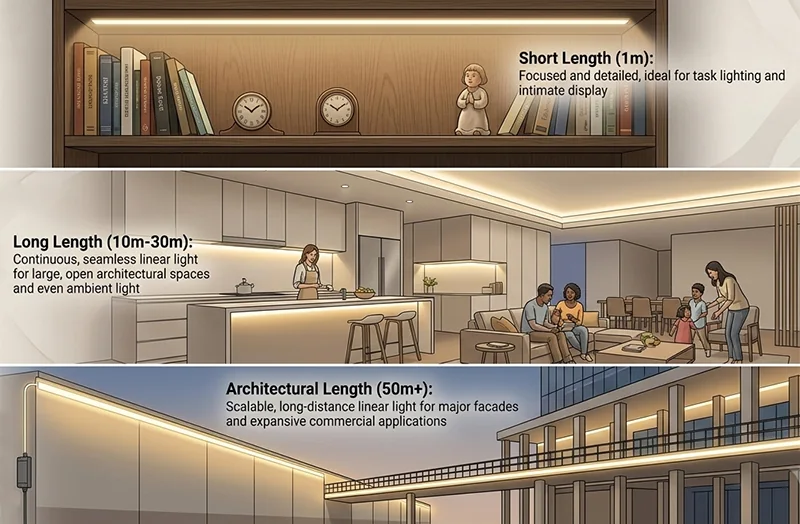
- High-output task or architectural run: compare measured output and heat, not only the LED count.
- Addressable COB: verify the IC and controller path separately from the COB construction.
CHECKPOINT / 03
Density, beam shape and diffuser still matter
A continuous phosphor line can soften hotspots, while a narrow-beam construction can reduce spill and direct light toward a wall or work surface. A clear cover preserves more output but may reveal the source; an opal cover hides more detail and usually costs some transmission. Increase the strip-to-cover distance when the profile allows it, then confirm the result in a mock-up. Optical uniformity and useful light are a tradeoff, not a single product attribute.
- Specify beam direction when the light grazes a wall or illuminates a work plane.
- Use the same profile and cover in the sample that will be used in the installation.
- Record whether the visual target is a line, wall wash, accent beam or task surface.
CHECKPOINT / 04
Match voltage and run length to the power plan
COB is available in multiple voltage families, but the exact run length, current and cut spacing depend on the selected product. A 24 V low-voltage configuration is often a practical starting point for architectural work; it still needs voltage-drop, injection and supply calculations. High-voltage AC products are a different safety and maintenance class and should not be mixed into a low-voltage DIY assumption.
strip_voltage = exact_variant_voltage
load_w = watts_per_m * length_m
plan = supply + cable + injection + thermal_path
CURRENT PRODUCT RECORDS
24 V WS2814 RGBW addressable LED strip View productCHECKPOINT / 05
Treat cut marks and thermal mounting as hard limits
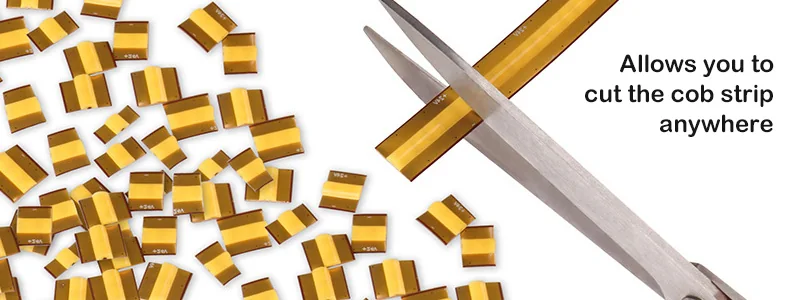
Standard COB strips can be cut only at their printed intervals. Any-cut products are a separate construction and must be identified in the product record before a free-form cut is attempted. The aluminum profile remains valuable even when the COB layer hides hotspots: it spreads heat, protects the board and gives the diffuser a stable position. Seal, bend and mount the selected variant according to its actual IP and mechanical instructions.
- Photograph the cut marks and first segment before trimming.
- Do not bend a strip tighter than its documented radius.
- Keep the power supply, connection and replacement path accessible.
VISUAL REFERENCES
See the layers before you specify the parts.
FAILURE MODES
What usually goes wrong
- COB is promised as perfectly dotless without checking density, cover and viewing distance.
- A narrow-beam or dark diffuser is chosen for a task-lighting role where its transmission is too low.
- A high-voltage COB run is treated like a safe low-voltage strip installation.
- An any-cut claim from one variant is applied to a standard strip.
- The aluminum profile is removed because COB hides dots, leaving the strip with no reliable thermal path.
TECHNICAL BASIS / VERSION
Keep the decision current
This guide is maintained as a versioned technical record. Recheck the current protocol documentation and the exact product revision before using it in a production installation.
Confirm the selected voltage, light engine, driver, controller, firmware and installation conditions against the product record and project brief.
FAQ / QUICK ANSWERS
Common questions about this lighting setup
Does COB always eliminate the need for a diffuser?
No. COB can hide hotspots at the source, but a diffuser still protects the strip, controls glare and creates a stable finish. Profile depth, density and viewing angle determine whether the cover is optional for the visual goal.
Is COB more efficient than SMD?
Do not assume it. Compare measured lumens per watt under the same color, temperature, drive and optical conditions. COBs main advantage is often visual uniformity and flexibility rather than a guaranteed efficiency gain.
Can I cut a COB strip at any point?
Only when the exact product is documented as any-cut. Standard COB tape has printed cut intervals, and waterproof treatment can add additional mechanical constraints.
READING LIST
Reference points used for this guide
The page is rewritten for LumaCircuit readers. These references establish the original topic or technical context; they do not replace an exact product review or a LumaCircuit test record.
- Reference article / COB LED strip basics