01 / Short answer
Power planning is a short calculation with several inputs: exact watts per metre, actual installed length, maximum state, voltage, branch layout and headroom. Use the result to select the supply and controller, then confirm it with a loaded test.
Buyers and installers turning strip length and watts per metre into a supply and controller size
CHECKPOINT / 01
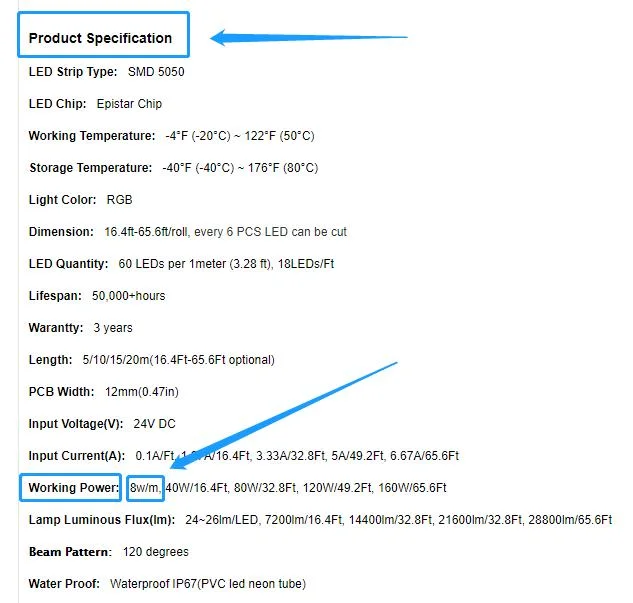
Read the exact watts per metre
Start from the configured strip record, not from an LED package name or a typical value found in a search result. Record voltage, watts per metre, color or channel state, IP construction and whether the figure is maximum or typical. A tunable-white or RGB strip may have a different full-state load from a single-color strip, and a controller can add its own small consumption.
- Use the maximum specified load when sizing the supply.
- Keep watts per metre tied to the exact voltage and variant.
- Do not copy a number from a different density, coating or color family.
CURRENT PRODUCT RECORDS
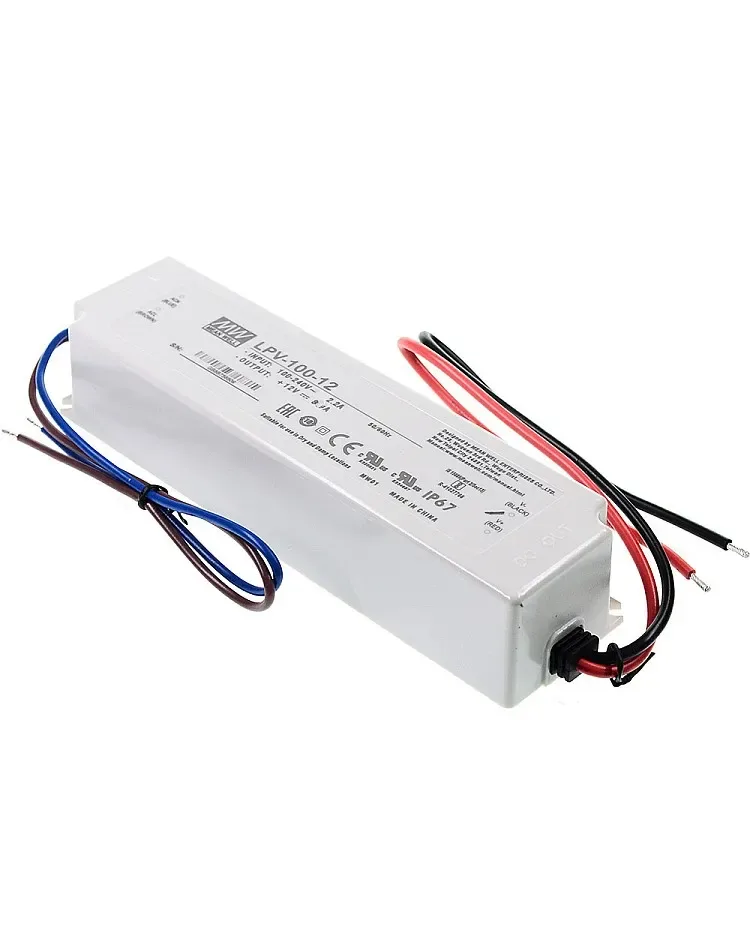
2216 CCT LED strip, 420 LEDs View product 100 W IP67 LED power supply View productCHECKPOINT / 02
Measure the installed length honestly
Length is the energized strip path, not the nominal reel length. Add the sections in every branch, include the cut plan and allow for a service loop or a replacement lead where the project needs one. If the final length is uncertain, calculate the upper bound and identify the point where a second branch or supply will be introduced. Custom length does not remove the need to check cut intervals and joints.
- Count every branch and do not double-count a parallel feed.
- Include a small, documented service allowance where access is difficult.
- Separate strip length from cable length because they lose voltage differently.
CHECKPOINT / 03
Apply the load and headroom formulas
The base calculation is watts per metre multiplied by energized metres. Convert watts to current by dividing by the operating voltage, then choose a supply with a practical planning margin. A 20 percent margin is a useful starting point for many constant-voltage layouts, but it is not a certification rule and it does not solve poor cooling, an undersized cable or an incompatible dimmer.
strip_w = watts_per_m * energized_length_m
strip_a = strip_w / voltage_v
planned_supply_w >= strip_w * 1.20
planned_supply_a >= strip_a * 1.20CHECKPOINT / 04
Size the controller and each branch too
The supply is only one limit. A PWM controller, decoder, connector, fuse, cable and distribution block each need a current rating for the way the load is divided. An RGB or RGBW controller must be checked per channel as well as in total. For a long layout, calculate each branch separately and decide where power enters the strip. Keep the control signal and power distribution in one readable drawing.
- Compare total current and per-channel current with the controller rating.
- Add branch protection that is appropriate for the cable and fault current.
- Use a separate power path where the strip length or current makes one-end feed unsuitable.
CURRENT PRODUCT RECORDS
100 W IP67 LED power supply View productCHECKPOINT / 05
Verify the calculation on the bench
After choosing a supply, connect a short sample and then the planned branch at the intended maximum state. Measure DC voltage at the supply and at the strip, observe the controller for resets, and check connector and profile temperature after the system stabilizes. Record the real current if the project needs a production BOM. A calculation is the design input; the loaded test is the evidence that the chosen assembly behaves as expected.
- Test the highest-current color or white state, not only a low-brightness scene.
- Recalculate if the strip, diffuser, cable or controller variant changes.
- Keep the formula and measured result with the project handoff.
CURRENT PRODUCT RECORDS
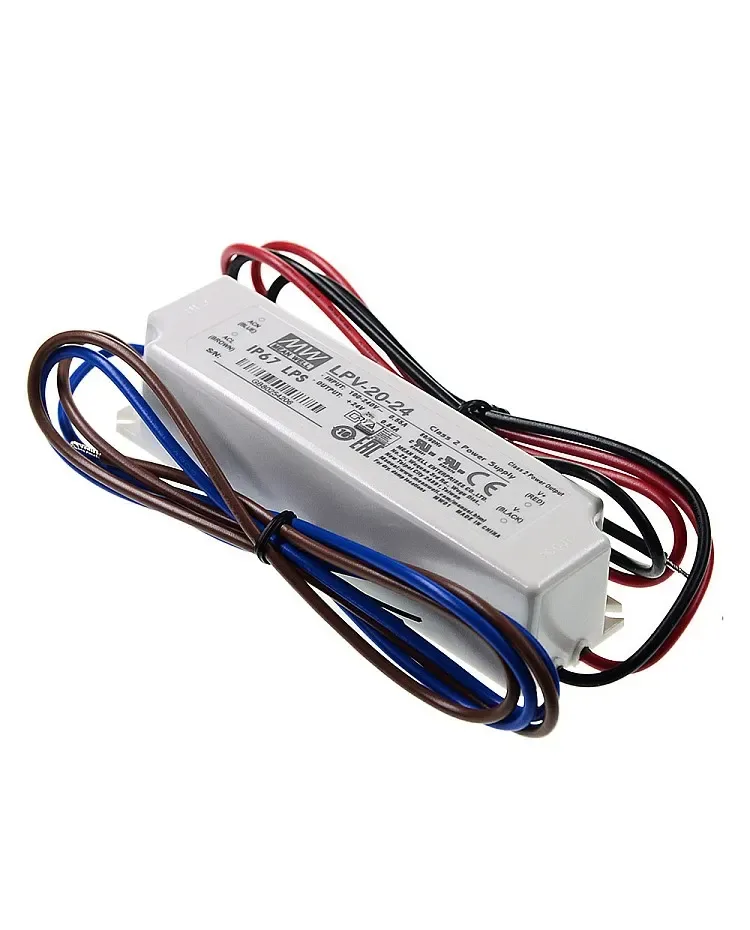
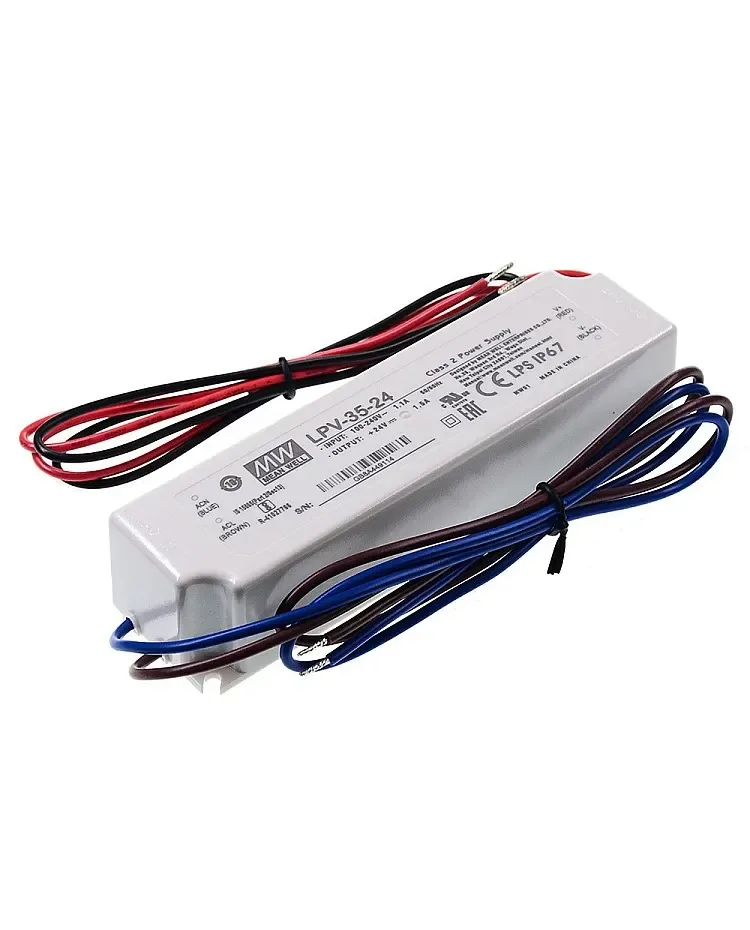
35 W waterproof LED power supply View product 100 W IP67 LED power supply View productFAILURE MODES
What usually goes wrong
- A typical watts-per-metre figure is used for a different strip variant.
- Reel length is counted instead of the actual energized branch length.
- Headroom is added to the supply but not to the controller, cable or connector limits.
- Per-channel current is ignored on RGB, RGBW or RGBCCT systems.
- The calculation is never checked at the maximum planned state after the diffuser and cable are installed.
TECHNICAL BASIS / VERSION
Keep the decision current
This guide is maintained as a versioned technical record. Recheck the current protocol documentation and the exact product revision before using it in a production installation.
Confirm the selected voltage, light engine, driver, controller, firmware and installation conditions against the product record and project brief.
FAQ / QUICK ANSWERS
Common questions about this lighting setup
How do I calculate the power for an LED strip?
Multiply the exact strip watts per metre by the energized length. Divide by the operating voltage to estimate current, then select a supply and controller with suitable headroom and branch protection.
Is a 20 percent power margin always enough?
It is a useful planning starting point for many constant-voltage systems, not a universal rule. Temperature, enclosure, duty cycle, cable, controller, certification and the actual variant can require a different decision.
Should I size the controller from the power supply?
No. Size the controller from the strip load, total current and per-channel current. The supply, controller, cable, connector and fuse all need to support the same physical branch plan.
READING LIST
Reference points used for this guide
The page is rewritten for LumaCircuit readers. These references establish the original topic or technical context; they do not replace an exact product review or a LumaCircuit test record.
- Reference article / calculating LED strip power and current