01 / Short answer
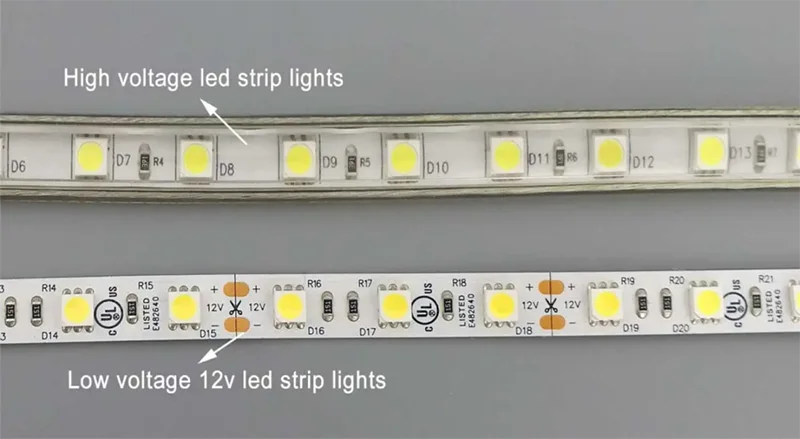
Low and high voltage are different electrical boundaries, not simply two run-length options. Low-voltage systems add an AC-to-DC supply and usually offer finer cut and service choices; line-voltage products can simplify long feeds but demand a stricter touch, enclosure and local-code review.
Designers choosing between low-voltage DC strip systems and line-voltage strip products
CHECKPOINT / 01
Separate the two system boundaries
A 5 V, 12 V, 24 V or 48 V strip is normally powered from a matching DC supply, with the mains connection contained at the supply. A line-voltage strip is a product designed for connection to the local AC system through its specified accessories and protection. The visual strip form does not tell you which boundary applies. Treat every line-voltage connection as mains work subject to local rules and qualified installation.
- Record input voltage, output voltage and supply topology separately.
- Keep low-voltage wiring physically and visibly distinct from mains wiring.
- Never connect a low-voltage strip directly to an AC outlet.
CURRENT PRODUCT RECORDS
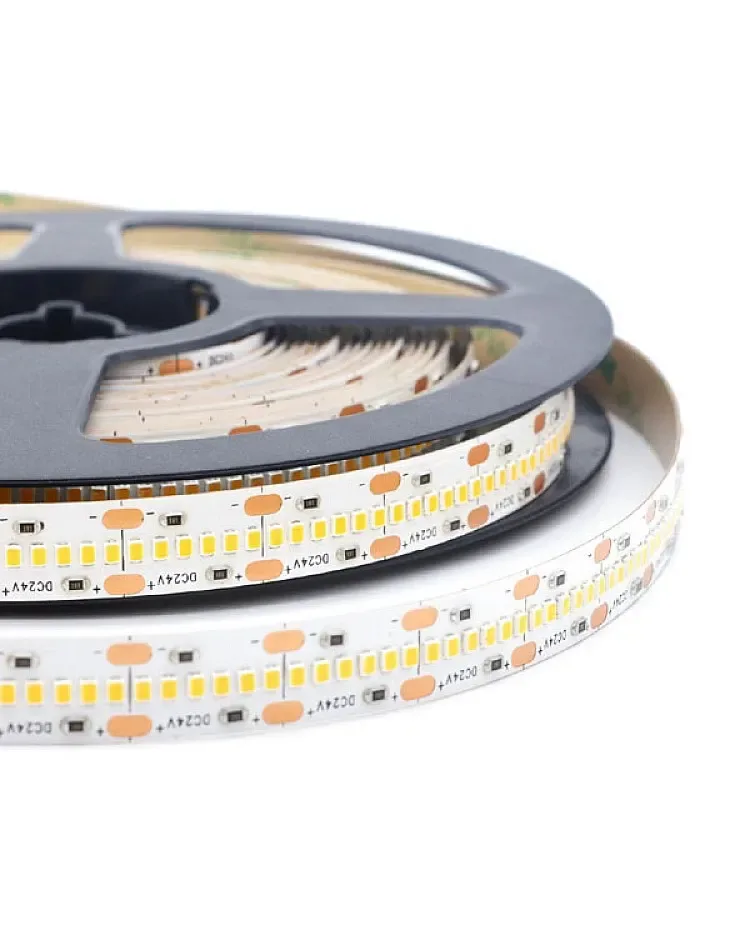
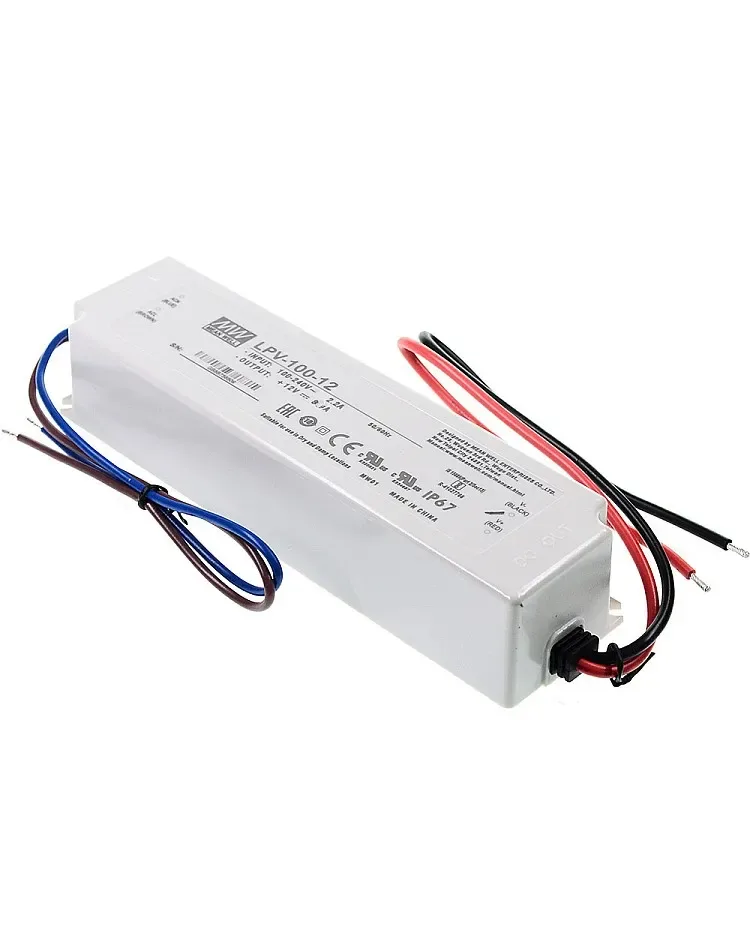
2216 CCT LED strip, 420 LEDs View product 100 W IP67 LED power supply View productCHECKPOINT / 02
Compare run planning by current, not marketing length
Higher voltage can reduce current for the same power, and that can make cable and distribution easier. It does not eliminate voltage drop, thermal load or the need to check the far end. Strip resistance, conductor area, cut interval, power density, injection points and controller limits still govern the installation. A stated reel length is a starting specification, not a permission to feed the whole length from one end.
- Calculate current at the actual voltage and watts per metre.
- Check the loaded voltage at the furthest section.
- Plan injection or parallel branches before the channel is ordered.
CURRENT PRODUCT RECORDS
2216 CCT LED strip, 420 LEDs View product 100 W IP67 LED power supply View productCHECKPOINT / 03
Cut resolution changes the installation workflow
Low-voltage strips often divide into smaller repeating circuits, which can make short furniture, shelving and cabinet dimensions easier to fit. Line-voltage products commonly use a different cut interval and accessory system, so their apparent simplicity can trade away length resolution. Addressable and COB products add their own cut and data rules. Choose the family from the dimensional tolerance of the project rather than from voltage alone.
- Map the shortest required segment before choosing the strip family.
- Keep end caps, connectors and injection leads in the cut plan.
- Do not use an assumed 5 V, 12 V or 24 V cut count as a product specification.
CHECKPOINT / 04
Match protection to access and environment
Low voltage reduces the energy at the strip but does not make an exposed joint or poor supply installation harmless. High voltage demands a controlled touch boundary, suitable insulation, correct protection and installation by a qualified person. IP protection addresses ingress testing, not every electrical hazard or every outdoor detail. For either family, review UV, condensation, heat, drainage, cable entries and service access as one assembly.
- Keep the supply in a dry, accessible location when the product allows it.
- Select the protection level from the actual exposure, not from a generic outdoor label.
- Keep line-voltage products out of reachable locations unless the complete system is designed for it.
CURRENT PRODUCT RECORDS
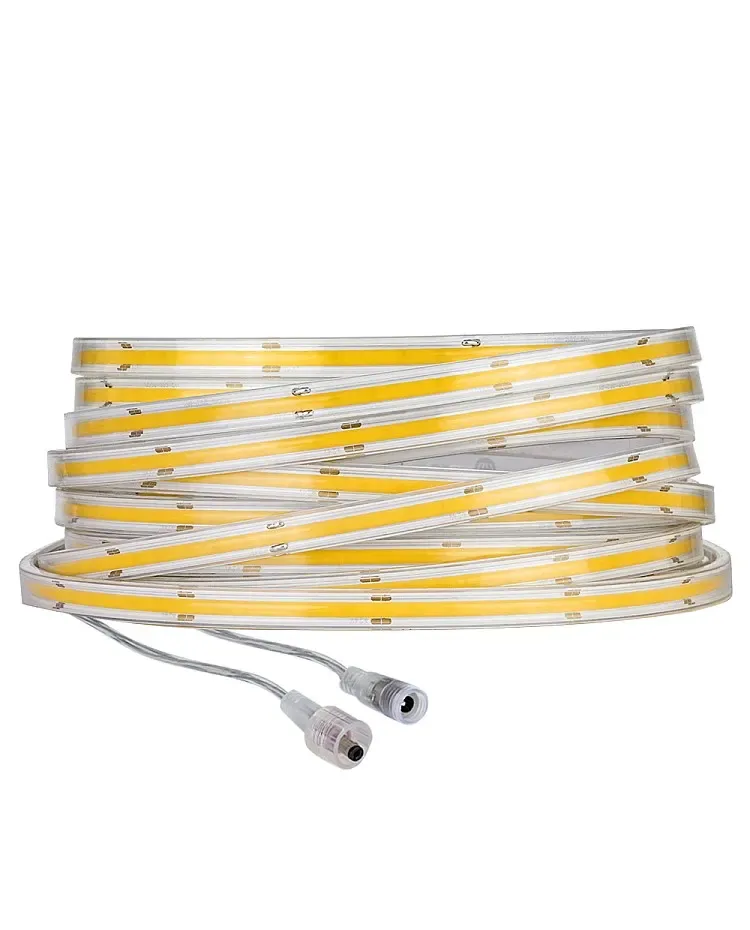
24 V IP67 CCT COB LED strip View product 100 W IP67 LED power supply View productCHECKPOINT / 05
Choose from the project constraint matrix
Use low voltage when the strip is accessible, the cut resolution matters, the control path needs a separate DC stage or the project benefits from easy bench testing. Consider a line-voltage product only when its complete accessory, protection and installation method fit a long architectural run and the local electrical design supports it. Approve a sample with the actual profile, cable route, controller and service plan before selecting the final family.
choose = access + cut_resolution + run_current + control_path
verify = local_code + environment + service_access
approve = sample_at_final_sightline && complete_boundary
CURRENT PRODUCT RECORDS
2216 CCT LED strip, 420 LEDs View product 24 V IP67 CCT COB LED strip View productVISUAL REFERENCES
See the layers before you specify the parts.
FAILURE MODES
What usually goes wrong
- A low-voltage strip is connected to mains because both products use a similar flexible PCB form.
- A longer advertised reel is treated as proof that voltage drop is solved.
- The cut interval and accessory system are discovered after the profile has been installed.
- An IP rating is used to justify an exposed high-voltage joint.
- The decision ignores the installer qualification, local code, controller and service boundary.
TECHNICAL BASIS / VERSION
Keep the decision current
This guide is maintained as a versioned technical record. Recheck the current protocol documentation and the exact product revision before using it in a production installation.
Confirm the selected voltage, light engine, driver, controller, firmware and installation conditions against the product record and project brief.
FAQ / QUICK ANSWERS
Common questions about this lighting setup
Is low-voltage LED strip always safer?
It reduces the voltage at the strip, but the supply, cable, fusing, joints and installation environment still need correct design. Safety depends on the complete system and local electrical requirements.
Does higher voltage eliminate voltage drop?
No. It can reduce current for a given power, but strip resistance, cable, connector, length and load still create voltage loss. Measure the installed branch under load.
Which voltage is best for a long LED strip?
Choose from the complete run, power, cut resolution, control, access, environment, protection and service plan. A sample and loaded measurement are more useful than a generic voltage ranking.
READING LIST
Reference points used for this guide
The page is rewritten for LumaCircuit readers. These references establish the original topic or technical context; they do not replace an exact product review or a LumaCircuit test record.
- Reference / choosing the electrical boundary for an LED strip run